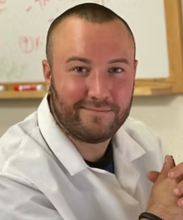
What do COVID-19 brain fog and ophthalmology have to do with Alzheimer’s disease? There may be more connections than one might think. Dr. Sean Miller is one of the scientists behind a recent study that used retinal tissue to investigate the links between COVID-19 infections and the build-up of amyloid and other indicators of Alzheimer’s disease in the central nervous system. Dr. Miller joins the podcast to discuss his research and its implications for COVID and dementia diagnosis and treatments in the future.
Guest: Sean Miller, PhD, research scientist, department of ophthalmology and visual science, Yale School of Medicine
Show Notes
Read Dr. Miller’s study, “SARS-CoV-2 induces Alzheimer’s disease–related amyloid-β pathology in ex vivo human retinal explants and retinal organoids,” on the journal Science’s website.
Learn more about Dr. Miller at his profile on the Yale School of Medicine website.
Read “Retinal pathological features and proteome signatures of Alzheimer's disease,” mentioned by Dr. Miller at 2:50, on the National Library of Medicine website.
Listen to our past episode, “Long COVID and Its Effect on Cognition,” on our website for more information on how COVID-19 can affect the brain.
Connect with us
Find transcripts and more at our website.
Email Dementia Matters: dementiamatters@medicine.wisc.edu
Follow us on Facebook and Twitter.
Subscribe to the Wisconsin Alzheimer’s Disease Research Center’s e-newsletter.
Enjoy Dementia Matters? Consider making a gift to the Dementia Matters fund through the UW Initiative to End Alzheimer’s. All donations go toward outreach and production.
Intro: I'm Dr. Nathaniel Chin, and you're listening to Dementia Matters, a podcast about Alzheimer's disease. Dementia Matters is a production of the Wisconsin Alzheimer's Disease Research Center. Our goal is to educate listeners on the latest news in Alzheimer's disease research and caregiver strategies. Thanks for joining us.
Dr. Nathaniel Chin: Welcome back to Dementia Matters. Brain fog is one of the most commonly reported symptoms following COVID-19 impacting an individual's thinking, memory and concentration. While not much is understood about how brain fog develops, a new study has found that COVID-19 can lead to a buildup of beta amyloid and other peptides related to Alzheimer's disease in the central nervous system, giving new insights into targets for treating brain brain fog as well as understanding how Alzheimer's disease develops. Joining us today to discuss this very important study is lead author Dr. Sean Miller, a research scientist in the Department of Ophthalmology and Visual Science at Yale University School of Medicine. Dr. Miller, welcome to Dementia Matters.
Dr. Sean Miller: Thank you so much for having me.
Chin: Before we get started, can you share a bit about how you got into ophthalmology and what led you to study the interconnections between the eyes and age-related disorders like Alzheimer's disease?
Miller: That's a fantastic question. It all started initially because I wanted to look at early disease detection. Back in undergraduate school and then also during my postgraduate doctoral program and postdoctorate program, I was really fascinated at designing therapies targeting Alzheimer's disease, specifically amyloid beta. However, the issue with a lot of these amyloid beta targeting or even neuroinflammatory drugs and therapies is its inability to essentially prevent disease onset. We're already targeting areas in which we have accumulations of amyloid beta, potentially hyperphosphorylation of tau and other properties associated with Alzheimer's disease. If we're able to intervene early with therapies–which means we have to detect disease early–we could actually treat before neurons die potentially preventing cognitive decline, memory loss and some of these other clinical symptoms associated with Alzheimer's disease. What had led me to look at the correlation was early disease detection. In 2023, a hallmark paper came out in Acta Neuropathologica that showed the proteome of the human retina in Alzheimer's disease patients. Really groundbreaking at this time where it really showed concretely that there's definitely pathology in Alzheimer's disease patients, similar pathology that's conserved with the brain such as the accumulation of amyloid beta or amyloid beta plaques. This presented me with an idea in which we see the accumulation and pathology in the Alzheimer's disease eyes as correlates to the human brain. Can we use the human eye–which is a clinically accessible noninvasive area–in order for us to screen amyloid beta? In our Science Advances recent manuscript, we also took human retinas from rapid autopsies from Alzheimer's disease patients postmortem, kept them alive in long-term culturing conditions and further established showing with our small molecule cronata-28–which is a curcumin derivative that binds amyloid beta and fluoresces–that we could also indeed detect it ex vivo. This further confirmed and validated the proteomic findings and also allowed us an in vivo or ex vivo marker such as cronata-28 to be able to visualize amyloid beta plaques in the retina.
Chin: Sean, it does sound like you've been interested from the very beginning in this idea of early detection because that would lead to early intervention. If you could detect early enough, you're talking about prevention even. Then it came to the eye, though. It sounds like you inherently didn't just gravitate to the eye, but that's through your training and research. Other publications you came to this realization, “Oh, we could do this through detecting proteins in the eye.” Does that seem fair?
Miller: Absolutely. That's absolutely kind of how the story evolved. I want to say that it's kind of an out-of-the-box idea to look at the human retina and the human eyes to study a brain disorder such as Alzheimer's disease. When I was initially thinking about it, there was a study that came out from Yale whose senior author was Dr. Brian Hafler that showed conserved phenotypes between microglia in the Alzheimer's disease brain and the Alzheimer's disease retina from sequencing data. I pitched the idea to world-leading retina specialist Dr. Brian Hafler, the senior author on our COVID manuscript in Science Advances, to essentially look at Alzheimer's disease pathology in the human retina using real clinical samples from patients themselves postmortem, and also we'll get in further about a real long COVID clinical screening we're performing at the Yale Eye Center.
Chin: That's a really good teaser, Sean. Before we get to that though, if you could share with our audience what exactly is this link or provide an overview of the connection between our eyes, vision and neurodegenerative processes like Alzheimer's disease dementia. What has the field in general shown? Because I do think you're right. Our listeners are initially thinking “We're talking about brain diseases here and now you're talking about the eyes and vision.” What is that connection?
Miller: The association with the eye and the brain is really because the eye being a component of the central nervous system is comprised of neurons, different types. We have microglia, we have astrocytes or macroglia-like cells and we have a blood-retinal barrier, all very similar properties to what we see in the brain where we see these mixed cell types but also the blood-brain barrier. The difference being that with the eye, instead of performing autopsies or biopsies of tissues, we can actually visualize the amount of pathology in the human retina just by noninvasive clinical imaging, which could potentially have hopes to screen large populations of people in order to detect the amount of amyloid beta that would be in the central nervous system.
Chin: Sean, there is some evidence too, right–I say this because we've had experts in audiology come on and talk about hearing loss and the connection to cognition, but there's also building evidence for visual loss or issues with vision and cognitive change. Does that relate to what you're talking about–he similar cells, the blood brain barrier, the retinal brain barrier or retinal blood barrier? Is that what you're seeing, too, in the field?
Miller: We can actually look at the eyes of Alzheimer's disease patients, see what we call gliosis. This is really the term in which we have inflammation in the retina very similar to what we get in the human brain of Alzheimer's disease patients. Additional impairments have actually been found with neurodegenerative disorders is actually with night vision. Your impairment of actually dark and light responses in your photoreceptors, for example, have been shown to be altered particularly in patients such as Parkinson's disease. What we've also been starting to evaluate with our Yale Eye Center is the differences in Alzheimer's disease patients between clinical and numerical data as well, which I'm sure we'll discuss at the end.
Chin: All right, then with that context, Sean, what led you to study the retinal tissue to understand these processes with proteins surrounding COVID in the brain? When did you make that step to the COVID-19 infection?
Miller: This was really focused at the antimicrobial peptide response. Again, going back to early disease detection really puts you around etiology. You're really just trying to figure out the development or progression of Alzheimer's disease. What I wanted to do was to further validate the human retina as a model of Alzheimer's disease. First we showed and characterized that we can visualize plaques. Second, to actually understand that now we have a good Alzheimer's disease ex vivo and in vitro model because we show it in retinal organoids and post-mortem Alzheimer's disease tissue. We have a good model in order for us to study and evaluate translational Alzheimer's disease. Next we want to say, “Okay, now what is the effect of antimicrobial peptides or amyloid beta against SARS-CoV-2?” We know that there's been papers, especially initially when the pandemic first started around 2020 and 2021, where a lot of milestone papers came out showing infiltration of SARS-CoV-2 into the central nervous system. They showed in choroid plexus, they showed in the cortex and they, of course, showed and confirmed it in the lung which is as expected. Which is really fascinating for us to say, okay, now we have not only a good model study of Alzheimer's, we're aware of the amyloid beta being an antimicrobial peptide and having that response against pathogens in the central nervous system. We know that SARS-CoV-2 or the virus that causes COVID-19 can infiltrate into the central nervous system. Lastly, we know that over 750 million cases have been confirmed with COVID-19. We know that roughly even around 10 percent of patients can develop long COVID-like symptoms which I'm sure we'll get to as well such as related to brain fog.
Chin: It just seemed like a ripe opportunity with the right numbers, the right connection and then what you're studying with early detection and the eyes. Before I ask my next question, Sean, our listeners are familiar with the amyloid cascade hypothesis. We talk a lot on this podcast about amyloid being one of the first identifiable proteins in this process, time going by leading to the development of neurofibrillary tangles, tau protein, within the neuronal cell or the brain cell–tau being very closely linked to neurodegenerative processes or atrophy early death of neurons–and then eventually having symptoms because of neuronal death and synaptic dysfunction. That is something that's been pretty well discussed on this podcast, but your study is leaning on something slightly different and you've mentioned it–this amyloid antimicrobial hypothesis. Before you talk about the results of your study in the paper, can you explain for our listeners what exactly is this hypothesis and how does it build on this overarching amyloid cascade hypothesis?
Miller: Absolutely. That's a fantastic question. I'm happy to discuss that. The antimicrobial peptide hypothesis of amyloid beta is really focused on an innate immune response against microbial pathogens. Your neurons, your astrocytes and other brain cells will actually secrete amyloid beta in response to pathogenic infections in the central nervous system in a way to suppress the spread of these pathogens. What we actually think with antimicrobial peptide is that these peptides that form oligomers and fibrils and plaques eventually actually fibrolyze and actually entangle or cause a mesh-like netting around pathogens in order to prevent their spread or what we would call amyloid beta encapsulating these pathogens, again, as an innate immune response in the central nervous system. With the antimicrobial peptide hypothesis it's starting to evolve even further, where now we're starting with viral flare-ups such as herpes simplex virus which has been largely led in and a very cutting-edge study a few years prior but also now with SARS-CoV-2. We know chlamydia, we know fungal infections in which we see that patients actually get repeated infections over their lifetime. We think about these repeated pathogenic infections kind of on a continuum where we form an innate immune response such as the encapsulation with amyloid beta around these pathogens. The idea being that you have these repeated what we would call waves or wave-like features in which you have high accumulations of amyloid beta during a flare-up or during an infection that enters or infiltrates the central nervous system. Then we believe that you get some residual clearance, such as microglia or some non-enzymatic and enzymatic processes. Overall you have a residual and trajectory of amyloid beta that accumulates with aging. We believe that the amyloid beta that we see even in regular aging–that patients get a little bit of amyloid beta–and without cognitive impairment–of course, we see that's exacerbated with patients with cognitive impairment–nonetheless is that we see that with aging it increases. This has led to what we call the amyloid beta wave hypothesis of Alzheimer's disease.
Chin: Sean, that was a great answer. I think for our listeners who might not be as technically versed, you're speaking a lot to inflammation. Infections being present driving inflammation but amyloid beta in this context not necessarily being a bad thing but actually a part of our body's response to the presence of an infection, part of this inflammatory fight against infections encapsulating it and being present. I think this is really important and why I'm so glad to have you on this podcast and the show today. Often people just assume amyloid is bad. Amyloid is the problem for Alzheimer's disease. What you're really showing and arguing is in certain contexts amyloid is meant to fight infections and be good for us. There comes this point where maybe there's too much or these waves or perhaps–correct me if I'm wrong–but there comes this tipping point where there's too much of it. Then that's what leads to this cascade that I already mentioned leading to tau. Am I saying that correctly from your experience?
Miller: Absolutely. Absolutely. You're spot on. That's correct.
Chin: Why I'm really excited to have you on the show is we can marry some of these ideas of the amyloid cascade and some of these other ideas of infection. I'm so glad you brought up herpes and chlamydia because actually that was one of my later questions for you of other infections. Because sometimes people think these are antagonizing ideas of, “Oh no, Alzheimer's is not amyloid, it's actually herpes infection.” Or I didn't hear you mention the oral hygiene of the certain bacteria in the mouth. They say it as if they have to be separate things. What you're actually discussing here is, well no, they are connected. These infections drive this buildup of amyloid and not necessarily to be a bad thing, but it just becomes a bad thing later on. Is that what you saw in your study that came out?
Miller: Yes. We saw even that, if you would treat with SARS-CoV-2 spike one protein, you get an immediate flare up or release of amyloid beta, which then over time, unless you repeated infection, starts to dampen off. It's almost like those waves actually are existent in which we're seeing a peak of amyloid and then kind of a settling down after that infection has been essentially immobilized, if you would say it that way.
Chin: Then how do you connect this whole process–the COVID infection, the waves or the acute spikes in amyloid–to brain fog? In that answer, I'm hoping, please define for us how you in the study defined brain fog, how that might be different than other terms that we might use like cognitive decline or cognitive impairment. How do you put all of that together?
Miller: Initially is that the idea with the connection between say brain fog, which is really a subjective term, right? It's a non-medical term that we've kind of evolved since really the pandemic has really led to us considering brain fog or again this non-medical subjective term. How we actually defined the brain fog for our study was really based on serological tests that were positive for SARS-CoV-2 or COVID and what we would consider a severe infection in their clinical reports. There was no cognitive impairment prior to the SARS-CoV-2 infection. The patients had died with severe COVID with a positive test. We confirmed that they had been evaluated for what they would write in their reports as cognitive impairment. There would be what we would call our again subjective terminology, which really just means cloudiness or say like an internal fuzziness in your brain when you're trying to think, which is memory or even different things of forgetfulness or difficulty multitasking. That say is brain fog, which a lot of times are post-infection. You would think of post a severe infection or whatnot, such as COVID, you get this brain fog. Brain fog compared to cognitive decline is a little bit different. Cognitive decline is actually more of a medical term and actually is associated with the decline over aging in which your ability for memory, cognition, even stuff such as difficulty with familiar tasks or reasoning. Sometimes you'll start to notice clinical symptoms such as deficits in communication as well. That's kind of like where we show the difference between cognitive decline and brain fog. Then where do we think that, okay, we see amyloid beta in COVID-19 patients that had severe infection upon, say, death. Then we're looking at their eye, which we know has amyloid beta that's associated with Alzheimer's. How does that connect now to the brain and brain fog? It's a very fascinating question and this is kind of what has led now to a new approach that we hopefully will have published very soon, is that we're actually looking to see, on an electrophysiological level around these plaques, what is actually happening with the neurocircuitry? Do we see changes in the amount of say potassium signaling or calcium signaling in specific neuronal populations that are only around plaques? If that's the case, we can actually do electrophysiological recordings in the retina to establish to see, do we see changes in the retina on this level that may be associated with what we see in the brain? And how the connection actually has is we're using these rapid autopsies to do electrophysiology around the plaques in these ex vivo, still viable cultures. That's kind of how we are thinking more that these plaques are causing a miscommunication or communication changes within the neurons around those plaques. That's kind of where this has led. We're now at Yale Eye Center. We are running, with the Long COVID Clinic here at Yale, retinal imaging for patients who have brain fog, who have had HIV, and who have also been our controls, or actually no cognitive impairment, age-matched controls. We're finding patients as young as even in their 40s with some what we would call proteinopathy that are associated with brain fog. It's really fascinating. Maybe we can make the connection between amyloid in the eye and cognitive dysfunction in the brain. One I just want to end on is that, in addition to the Yale Eye Center that we're evaluating, is we're actually establishing artificial-based tools such as machine learning that goes and does the detection of patterns or fluorescence, or what we would actually look at is hypopigmentation in the retina, and for proteinopathy on just a regular eye exam. Within about 10 seconds you can actually screen about 40 different patients who have their what we call fundus autofluorescence microscopy with their artificial-based model in order to say yes or no with a disease classifier, are we detecting abnormal protein deposition versus say normal with aging? Again, this is with establishment with the Long COVID Clinic and the Yale Eye Center.
Chin: That's incredible, Sean. I mean, it's always exciting when we talk about artificial intelligence, AI, machine learning. I mean, you're really using lots of rich data and help and getting the assistance from machine learning to do it. What you're speaking to shows the true benefit of these rapid autopsies because I wasn't really fully grasping it until that answer of these are really generous individuals who are dying, knew they were about to die, consented to having this done. That allowed for you to have really living tissue, post their death but living tissue, that you could then study and you mentioned in your answer, not only you have this incredible resource thanks to this unbelievable donation, now you're also looking at HIV. It does go to my question that I wanted to ask earlier. Is there something unique to viruses or these other bacteria that you mentioned, chlamydia, and then I mentioned the oral dental? Is there something where it has to be a head and neck infection? What makes you think certain organisms are triggers versus others? Do we have a theory behind that?
Miller: That's a great question. To be honest, when it comes to specificity of, say, amyloid beta versus these pathogens, I just don't think the literature is enough out there to really establish, is it ubiquitous or is it a common mechanism that happens or is it specific to certain viruses or pathogens such as gingivitis or some of these other ones as well? One thing I want to mention though is that these more severe infections cause systemic inflammation. I think we'll probably end up touching on it is more in which the systemic inflammation also impairs the blood-brain barrier and also the blood-retinal barrier, which makes it more permeable. It allows more infiltration of pathogens with aging because in aging we have a natural lost integrity of the blood-brain barrier, but in Alzheimer's it’s exacerbated. This is actually in higher risk populations. The systemic inflammation that is actually worsening even your blood brain barrier which is allowing even more infiltrates of these pathogens into the central nervous system.
Chin: No, that actually, Sean, that was my next question about the blood-brain barrier because I read that in your paper. That seems to be a very critical part of this idea of an infection, because some infections can actually just be in the brain, right? They identify the virus or the bacteria on autopsy. What you're saying too is other infections create whole body inflammation, loosens up sort of the blood-brain barrier which allows for more infections to get in or at least inflammatory proteins. Am I saying that correctly?
Miller: Absolutely. That's exactly at least where the thought of mine has been going and I think some of the research is leading to in the field.
Chin: Well one, it shows the importance of the integrity of our blood-brain barrier. You've given me an idea for another podcast, so thank you, Sean. I also read in your paper, you mentioned this target, amyloid aggregation being reversed in your study when you targeted an anti-tumor site. You’ve been talking about infections and inflammation, but then your paper also talks about anti-tumor sites. What is the connection with this?
Miller: Fantastic question and really excited to actually get into this one. How we actually first started to look at it was we did single-cell RNA sequencing from post-mortem Alzheimer's disease, again these rapid autopsies, patients from their retinas. We compared it to age match controls as well. We also have done COVID. What we found was that instead of being ACE2, which is a common receptor that people think about when they think about the SARS-CoV-2, we actually found another receptor especially on neurons called neuropilin-1, which has been, as you mentioned, associated with tumors. With this we found that through spike one protein–this is the mechanism in which we're able to elucidate–is that it is binding to neuropilin-1 and then increasing amyloidogenic pathways. There was a paper that potentially showed it working through gamma-secretase. There's some really fascinating research coming out recently kind of surrounding this topic. We did find that if you block this interaction with neuropilin-1 blockers or inhibitors at the same time you're exposed to SARS-CoV-2 spike one protein, we found that there was a lack of accumulation of amyloid beta suggestive that the MOA or mechanism of action would actually be this neuropilin-1 receptor since we don't see ACE2 on neurons. There is a beautiful paper that actually showed that neurons can be infected with SARS-CoV-2 through neuropilin-1. It was a beautiful Science article.
Chin: I see. Now we're getting a level deeper and you're saying, we see this relationship with COVID-19 and amyloid, but then you went further and you're able to show now we can see how this is happening. It is through this receptor that deals with tumors.
Miller: Yep, absolutely. I just want to add is that listeners out there will think, “Okay, well, how are you supposed to be treated with a neuropilin-1 inhibitor the second that you get SARS-CoV-2 when you may not know you have SARS-CoV-2 until testing,” for example, and unfortunately nowadays it is less frequent for people to test themselves for COVID-19 as it was during the peak of the pandemic. Nonetheless, if we're able to, instead of doing a treatment at the same time that you're exposed to the SARS-CoV-2 spike one protein or SARS-CoV-2 infection, is to be able to treat it a few days after. The idea is instead of an antiviral drug, if you think of it that way, it would actually be an anti-amyloid drug or an amyloid-enhancing drug due for clearance, where you'd actually clear out excessive amyloid or reduce the amount of amyloid that's being produced. The idea would be that maybe it works as an antiviral or maybe it is just an anti-amyloid, but it could have both mechanisms or it could work both ways even. I think that that is a better approach than trying to target initially, which shows the great MOA, right? That was the goal, to show the mechanism of action was clean. We understood it was through that from single-cell RNA sequencing. One thing and a very fascinating thing, I'm sorry that I didn't mention, for our drug screening–and this was in the article–is that we actually made human retinal organoids. We took blood draws from patients– and these are from controls and also from Alzheimer's disease–and we can make them into induced pluripotent stem cells (iPSCs) and then differentiate and mature them into human retinal organoids that are multicellular and reconfigulate the cell types in the retina of the human. We then use high throughput screening, so we did drug screening with different neuropilin-1 blockers. This was using, again, that CRANAD-28 or curcumin fluorescent derivative that binds to amyloid beta 42 in which we would essentially just add spike one protein, add this CRANAD-28, see increases in fluorescence in green, for example, with CRANAD-28, which targets amyloid, and then just apply a lot of drugs to essentially see where do we get rid of these plaques. We found that an optimal neuropilin-1, which we had published in the paper, worked really well.
Chin: No, thank you for explaining that process. I just think that, even for those of us that don't fully understand everything you just said, we can appreciate that this is what leads to eventual new targets, new ways of treating disease. Especially since you're showing this antimicrobial amyloid connection, that it’s not just for knowledge sake. There is an actual opportunity then for drug treatment. Sean, that kind of leads to my last question today, which is really it seems like there's lots of next potential steps, but where is your research in particular going from here? Are you going to be continuing to focus on this antimicrobial hypothesis? Are you going to move into clinical trials? Are you going to do different drug development? I mean, where do you see the next few years?
Miller: The future is pretty exciting I would say, at least in that way, is that not only do we have the ability now to look at the antimicrobial peptide response in our human models, but we can also now start doing drug screenings, rapid drug screenings with even more additional targets with our organoid model. We are currently having that go on right now with high-content imaging. Not only will we find additional drug candidates and targets with our high-throughput organoid screening, we not only have that and those candidates that then will hopefully lead to clinical trials. In parallel, to understand can we even use the retina to further understand in the clinic. Again, I mentioned it a little bit earlier, in collaboration with the Long COVID Clinic at Yale and then with Dr. Brian Hafler, who’s a senior author, and myself as lead author on the paper, we now are working with the Yale Eye Center to do clinical screening for proteinopathies in the retina of real patients. This is ongoing and we’re still, of course, recruiting so always happy to help anyone or answer questions regarding that. That’s our goal is like, can we get CRANAD-28 to the clinic so that we can look specifically at amyloid beta in the retina? That’s one step. In parallel, we are also working again with the artificial intelligence based tools to do patterns and to recognize, into our disease classifier, when do you reach a threshold that’s essentially what we would consider too much amyloid. Then, in addition to that would be that we’re still trying to figure out this antimicrobial wave hypothesis or amyloid beta wave hypothesis of Alzheimer's disease. Drug candidates with drugs, or sorry–drugs candidates from our high-throughput screening, Yale clinical screening with proteinopathies, and trying to get something specific for amyloid beta so we can distinguish between other proteins or even lipids and amyloid beta when we do our just regular eye exams that take just a few minutes.
Chin: Well, that is all very exciting, Sean. For our listeners who are in the Yale area, I am certainly happy for this podcast to be a recruitment source for you. If you are interested, it sounds like you should contact Dr. Sean Miller. Very exciting trials or studies happening. I certainly look forward to those next publications, Sean. Let’s end here today. I want to thank you for being on the show. We certainly are excited about the future papers coming from you.
Miller: Appreciate it so much. This was a fabulous conversation, I really appreciate it.
Outro: Thank you for listening to Dementia Matters. Follow us on Apple Podcasts, Spotify or wherever you listen. Or tell your smart speaker to play the Dementia Matters podcast. Please rate us on your favorite podcast app. It helps other people find our show and lets us know how we're doing. If you enjoy our show and want to support our work, consider making a gift to the Dementia Matters Fund through the UW Initiative to End Alzheimer's. All donations go toward outreach and production. Donate at the link in the description. Dementia Matters is brought to you by the Wisconsin Alzheimer's Disease Research Center at the University of Wisconsin–Madison. It receives funding from private, university, state and national sources, including a grant from the National Institutes on Aging for Alzheimer's Disease Research. This episode of Dementia Matters was produced by Caoilfhinn Rauwerdink and edited by Alexia Spevacek. Our musical jingle is “Cases to Rest” by Blue Dot Sessions. To learn more about the Wisconsin Alzheimer's Disease Research Center, check out our website at adrc.wisc.edu. That's adrc.wisc.edu and follow us on Facebook and Twitter. If you have any questions or comments, email us at Dementia Matters at medicine.wisc.edu. Thanks for listening.